
รับสมัครสอบ!
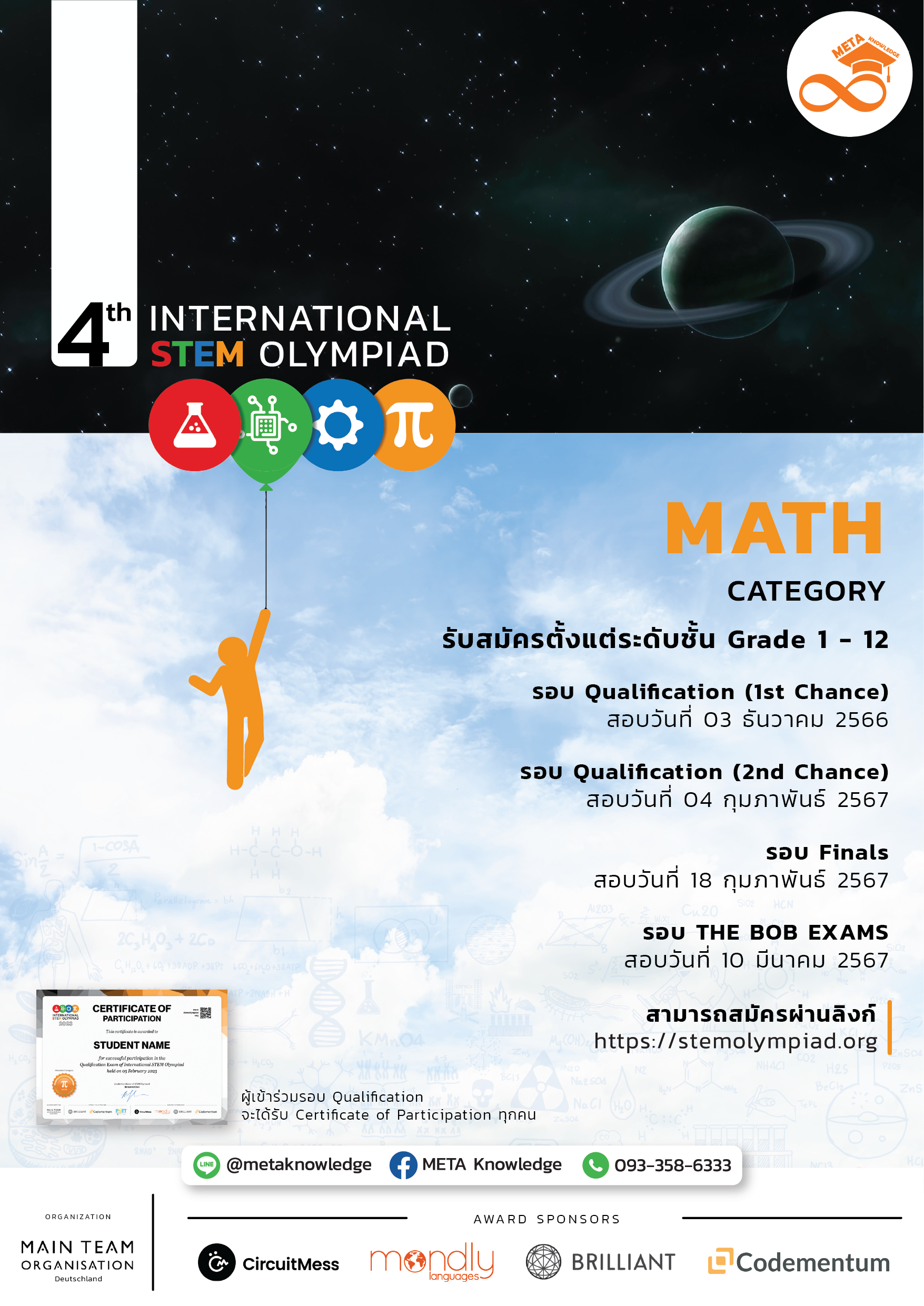
STEM OLYMPIAD - MATH
รอบ Qualification
รับสมัครสอบตั้งแต่วันนี้เป็นต้นไป!
ระดับชั้น: Grade 1 - 12
Days
Hours
Minutes
Seconds
รับสมัครสอบ!

STEM OLYMPIAD - Math
รอบ Qualification
รับสมัครสอบตั้งแต่วันนี้เป็นต้นไป!
ระดับชั้น: Grade 1 - 12
รับสมัครสอบ!
STEM OLYMPIAD - Math
รอบ Qualification
รับสมัครสอบตั้งแต่วันนี้เป็นต้นไป!
ระดับชั้น: Grade 1 - 12
หัวข้อที่ใช้สอบ
GRADE 1
- Number Recognition and Counting: – Recognizing and writing numbers from 1 to 100. – Counting forward and backward up to 100.
- Addition and Subtraction: – Basic addition facts up to 20 (e.g., 1+1, 2+2, etc.). – Simple subtraction within 20.
- Shapes and Patterns: – Identifying and naming basic 2D shapes (e.g., circle, square, triangle). – Extending simple patterns (e.g., AB, ABB).
- Measurement: – Comparing and ordering objects by length, weight, and size. – Understanding terms like “longer,” “shorter,” “heavier,” and “lighter.”
- Time: – Telling time to the hour and half-hour on analog clocks.
- Mone – Recognizingy: and counting coins (penny, nickel, dime, quarter).
- Data and Graphs: – Interpreting basic picture graphs and bar graphs with pictorial representations.
- Basic Word Problems: – Simple word problems involving addition and subtraction with objects or pictures.
GRADE 2 - 3
- Number Sense: – Addition and subtraction within 100. – Skip counting (e.g., counting by 2s, 5s, 10s). – Comparing and ordering numbers. – Basic understanding of place value.
- Basic Operations: – Multiplication and division (for grade 3 students). – Solving simple word problems involving addition, subtraction, and multiplication.
- Measurement: – Length: Comparing and measuring objects using non-standard units (e.g., paper clips, cubes) and standard units (e.g., centimeters, meters). – Time: Reading and telling time on analog and digital clocks (hours and half-hours).
- Geometry: – 2D Shapes: Identifying and describing common shapes (e.g., squares, rectangles, triangles, circles). – 3D Shapes: Identifying and describing common solids (e.g., cubes, spheres, cylinders).
- Data and Graphs: – Reading and interpreting simple pictographs and bar graphs.
- Patterns and Sequences: – Recognizing and extending number patterns.
- Fractions: – Introduction to fractions as parts of a whole (e.g., halves and quarters) for grade 3 students.
GRADE 4-5
- Number Sense and Operations: – Addition, subtraction, multiplication, and division of multi-digit numbers. – Understanding place value up to thousands and beyond. – Rounding numbers to the nearest ten, hundred, or thousand.
- Fractions and Decimals: – Comparing and ordering fractions and decimals. – Adding and subtracting fractions with common denominators. – Converting fractions to decimals and vice versa.
- Measurement: – Length, weight, capacity, and volume using standard units (e.g., centimeters, grams, liters). – Converting between different units of measurement (e.g., meters to centimeters, kilograms to grams).
- Geometry: – Classifying and identifying 2D shapes (e.g., polygons, quadrilaterals) and 3D shapes (e.g., prisms, pyramids). – Understanding angles and their measurements. – Symmetry and transformations (e.g., reflections, translations).
- Data and Graphs: – Reading and interpreting more complex bar graphs, line plots, and line graphs. – Understanding measures of central tendency (e.g., mean, median, mode).
- Patterns and Algebra: – Identifying, extending, and creating number patterns and sequences. – Basic algebraic expressions and equations (e.g., solving for unknowns).
- Word Problems and Real-Life Applications: – Multistep word problems involving all four operations. – Applying mathematical concepts to real-life situations.
GRADE 6-7
- Number Sense and Operations:
– Operations with integers (positive and negative numbers).
– Order of operations (PEMDAS/BODMAS) for evaluating expressions.
– Prime and composite numbers, factors, and multiples. - Fractions, Decimals, and Percentages:
– Operations with fractions and mixed numbers (addition, subtraction, multiplication, division).
– Converting between fractions, decimals, and percentages.
– Solving percentage problems. - Measurement:
– Converting between different units of measurement (e.g., metric to imperial units).
– Perimeter, area, and volume calculations for various shapes.
– Time and distance problems involving speed and rates. - Geometry:
– Properties of 2D shapes (e.g., triangles, quadrilaterals).
– Calculating angles in polygons and parallel lines.
– Volume and surface area of 3D shapes (e.g., prisms, cylinders). - Data and Statistics:
– Probability concepts and calculations.
– Analyzing and interpreting data from tables and charts.
– Measures of central tendency and dispersion (mean, median, mode, range). - Algebra:
– Solving equations with one variable.
– Simplifying algebraic expressions and combining like terms.
– Graphing linear equations. - Ratios, Proportions, and Rates:
– Solving problems involving ratios and proportions.
– Understanding rates and unit rates. - Word Problems and Real-Life Applications:
– Complex word problems involving multiple concepts and operations.
– Applying mathematical skills to real-life scenarios.
GRADE 8-9
- Number Systems:
– Rational and irrational numbers.
– Operations with exponents and scientific notation.
– Understanding square roots and cube roots. - Algebra:
– Solving linear equations and inequalities with one variable.
– Systems of equations with two variables.
– Factoring quadratic expressions. - Geometry:
– Properties of angles and triangles (e.g., Pythagorean theorem, special triangles).
– Similarity and congruence of figures.
– Trigonometry basics (sine, cosine, tangent) for right-angled triangles. - Coordinate Geometry:
– Plotting and analyzing points on the coordinate plane.
– Calculating distance and midpoint between two points. - Data Analysis and Probability:
– Advanced data interpretation from various types of graphs and charts.
– Calculating probability for independent and dependent events. - Functions:
– Understanding basic concepts of functions (domain, range, mapping).
– Graphing linear and exponential functions. - Statistics:
– Measures of central tendency and variability for large datasets.
– Constructing and interpreting box-and-whisker plots. - Ratios, Proportions, and Percentages:
– Solving problems involving proportions and percentages.
– Applications of percentage increase and decrease. - Real Numbers and Operations:
– Understanding properties of real numbers (associative, commutative, distributive).
– Solving problems involving mixed operations with real numbers. - Word Problems and Applications:
– Complex word problems involving multiple concepts and operations.
– Applying mathematical skills to real-life scenarios and practical situations.
GRADE 10-12
- Probability:
– Calculating probabilities of simple and compound events.
– Applying the concepts of independent and dependent events.
– Solving problems using permutations and combinations. - Basic Statistics:
– Measures of central tendency (mean, median, mode) and variability (range).
– Representing data using histograms, bar charts, and pie charts.
– Introduction to standard deviation and variance. - Trigonometry:
– Trigonometric ratios (sine, cosine, tangent) for acute angles.
– Solving right-angled triangle problems using trigonometry.
– Understanding the unit circle and trigonometric identities. - Coordinate Geometry:
– Equations of lines and circles in the Cartesian plane.
– Finding slopes and intercepts of lines. - Geometry:
– Properties of polygons and regular polygons.
– Understanding congruence and similarity of triangles and other shapes.
– Solving problems involving area and volume of basic figures. - Probability Distributions:
– Understanding and using binomial and normal distributions.
– Interpreting z-scores and standardizing data. - Advanced Word Problems:
– Challenging word problems involving multiple concepts and real-life applications.
– Applying mathematical skills to practical scenarios. - Conic Sections:
– Understanding the equations and properties of circles, ellipses, parabolas, and hyperbolas.
– Graphing conic sections in the Cartesian plane. - Complex Numbers:
– Understanding and performing operations with complex numbers.
– Representing complex numbers in polar form.