
รับสมัครสอบ!
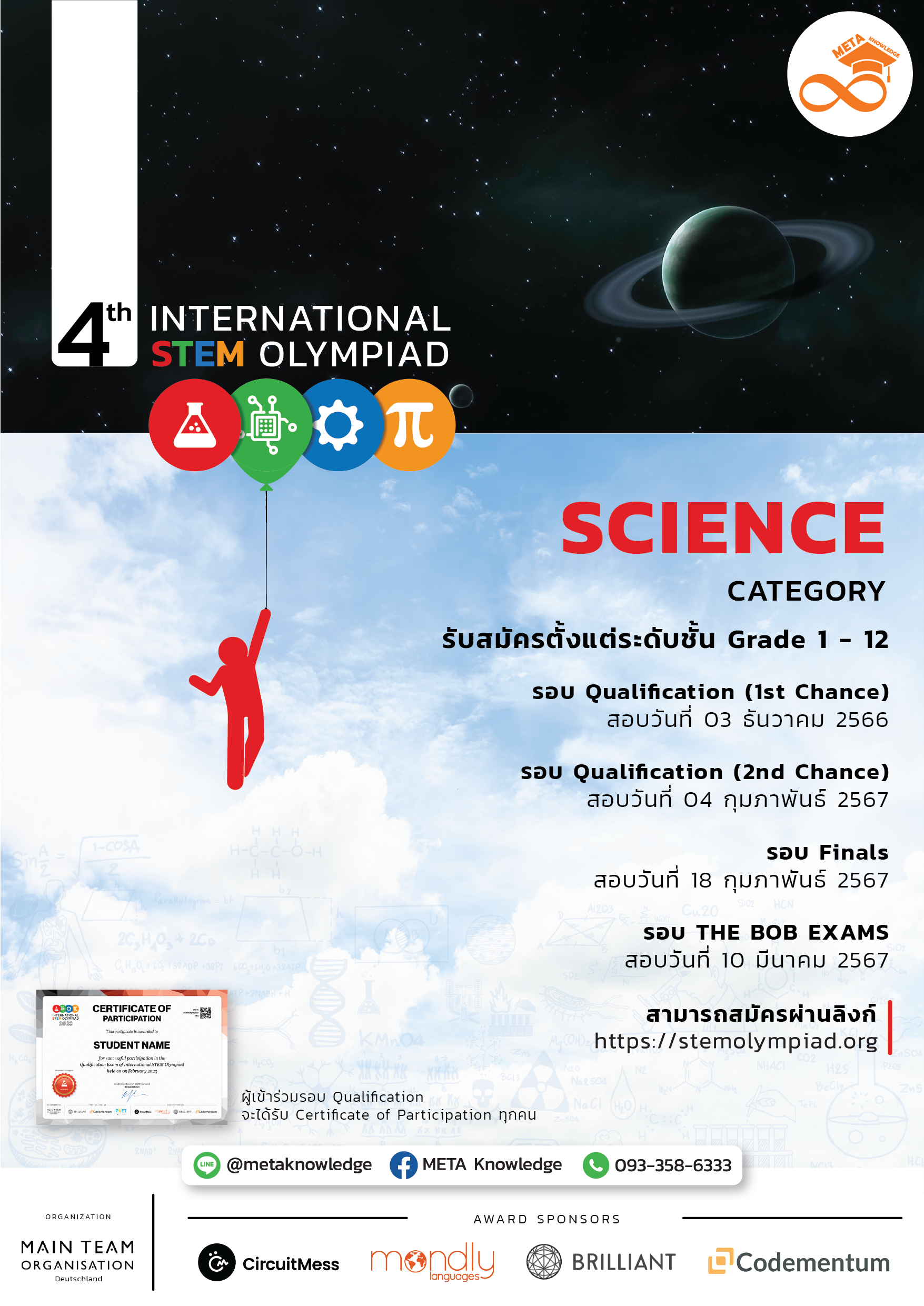
STEM OLYMPIAD - SCIENCE
รอบ Qualification
รับสมัครสอบตั้งแต่วันนี้เป็นต้นไป!
ระดับชั้น: Grade 1 - 12
Days
Hours
Minutes
Seconds
รับสมัครสอบ!
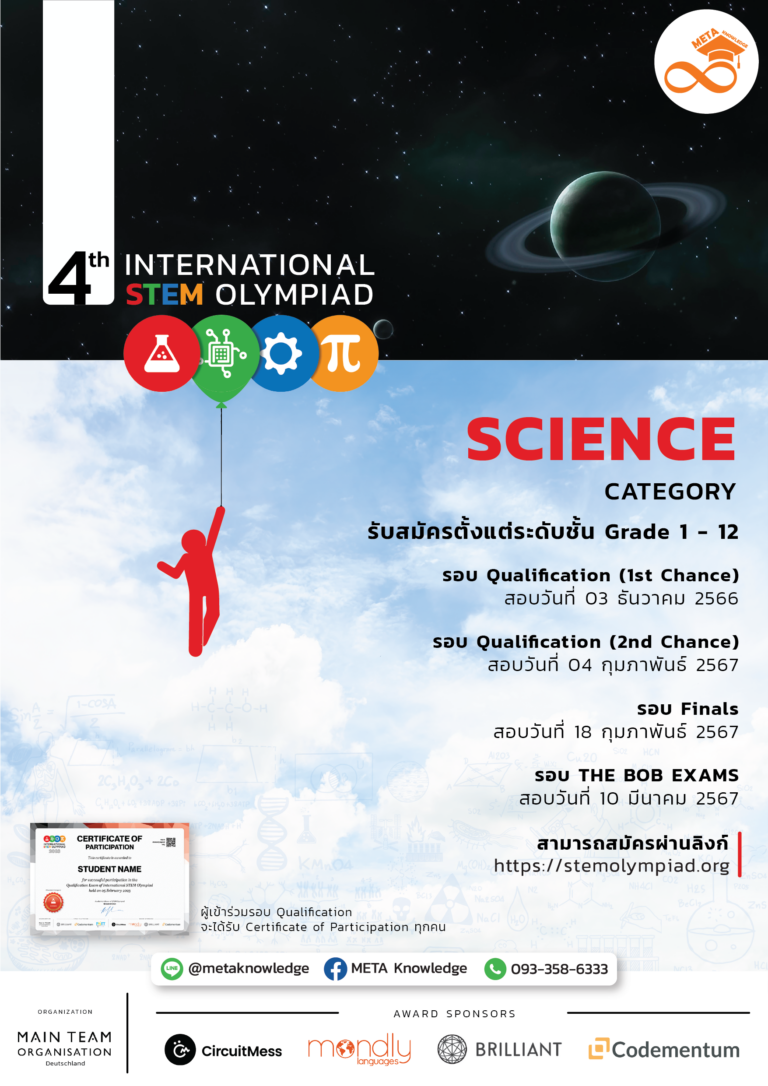
STEM OLYMPIAD - Science
รอบ Qualification
รับสมัครสอบตั้งแต่วันนี้เป็นต้นไป!
ระดับชั้น: Grade 1 - 12
รับสมัครสอบ!
STEM OLYMPIAD - Science
รอบ Qualification
รับสมัครสอบตั้งแต่วันนี้เป็นต้นไป!
ระดับชั้น: Grade 1 - 12
หัวข้อที่ใช้สอบ
GRADE 1
- Plants and Animals: Basic knowledge about different plants and animals, their characteristics, and their habitats.
- Seasons and Weather: Introducing the concept of seasons and basic weather conditions like rain, sunshine, and wind.
- Five Senses: Exploring the five senses (sight, hearing, taste, smell, touch) and how they help us experience the world.
- Matter and Materials: Simple understanding of different materials and their properties (e.g., hard, soft, rough, smooth).
- Light and Shadows: Basic concepts of light and shadows, and how shadows change with the position of the light source.
- Healthy Habits: Promoting the importance of healthy habits like eating nutritious food, regular exercise, and personal hygiene.
- Living and Non-Living Things: Differentiating between living (plants and animals) and non-living things (rocks, toys, etc.).
- Water and Its Properties: Introducing the properties of water, its uses, and importance for living things.
- Magnets and Magnetism: Basic introduction to magnets and simple magnetism experiments.
- Simple Machines: Familiarizing students with simple machines like levers, pulleys, and wheels.
- Environmental Awareness: Raising awareness about caring for the environment and conservation.
- Basic Measurement: Introduction to basic measurements like length and weight using simple tools.
- Shapes and Patterns: Exploring basic shapes and patterns in everyday objects.
- Animal Characteristics: Learning about various animal characteristics, such as fur, feathers, scales, and how they move.
- Our Solar System: Introducing the concept of the sun, moon, and stars in our solar system.
GRADE 2 - 3
- Plants and Animals: Students can be asked questions about different types of plants and animals, their life cycles, habitats, and adaptations.
- States of Matter: Basic concepts of solids, liquids, and gases, and how they change from one state to another.
- Earth and Space: Questions related to the Earth’s rotation, seasons, day and night, the moon, and stars.
- Weather and Seasons: Understanding different weather conditions and how seasons change.
- Human Body: Basic knowledge about the human body’s organs, senses, and the importance of healthy habits.
- Magnets and Electricity: Introducing the concept of magnets, static electricity, and simple circuits.
- Simple Machines: Familiarizing students with simple machines like levers, pulleys, wheels, and inclined planes.
- Sound and Light: Exploring how sound is produced, how it travels, and basic properties of light.
- Environmental Awareness: Educating students about the importance of protecting the environment, recycling, and conserving resources.
- Scientific Inquiry: Introducing the scientific method and basic experimental concepts.
- Matter and Its Properties: Understanding the properties of matter, such as mass, volume, and density.
- Basic Chemistry: Introducing the idea of elements and compounds, as well as basic chemical reactions like mixing acids and bases.
- Force and Motion: Concepts related to force, motion, and how objects move.
- Observations and Patterns: Encouraging students to make observations and recognize patterns in the natural world.
- Astronomy: Basic concepts about planets, the solar system, and space exploration.
GRADE 4-5
- Solar System and Planets: Questions about the planets in our solar system, their characteristics, and their orbits.
- States of Matter: Understanding the different states of matter (solid, liquid, gas) and how they change under various conditions.
- Ecosystems and Food Chains: Exploring different ecosystems, food chains, and the interdependence of organisms.
- Human Body Systems: Basic knowledge about the major systems of the human body, such as the circulatory, respiratory, digestive, and nervous systems.
- Forces and Motion: Concepts related to forces, motion, and simple machines.
- Electricity and Circuits: Understanding the basic principles of electricity and simple circuits.
- Magnets and Magnetism: Exploring the properties of magnets and how they interact with other materials.
- Sound and Light: Understanding the properties of sound and light, how they travel, and how they interact with objects.
- Rocks and Minerals: Learning about different types of rocks, their formation, and their uses.
- Life Cycles: Understanding the life cycles of plants and animals, including metamorphosis and reproduction.
- Weather and Climate: Questions about weather patterns, climate zones, and climate change.
- Environmental Conservation: Raising awareness about the importance of environmental conservation and sustainable practices.
- Scientific Method and Inquiry: Introducing the scientific method and the process of conducting scientific investigations.
- Adaptations and Survival: Understanding how animals and plants adapt to their environments for survival.
- Simple Chemical Reactions: Introducing basic chemical reactions and their applications.
GRADE 6-7
- Cells and Microorganisms: Understanding cell structure, cell functions, and the diversity of microorganisms.
- Genetics and Heredity: Basic concepts of genetics, inheritance, and genetic variation.
- Earth’s Structure and Plate Tectonics: Exploring the layers of the Earth, plate movements, earthquakes, and volcanoes.
- Energy and Energy Transfer: Understanding different forms of energy, energy transfer, and conservation of energy.
- Human Body Systems: In-depth knowledge about the major systems of the human body and their interactions.
- Ecology and Ecosystems: Exploring the relationships between organisms and their environments, including food webs and energy flow.
- Chemical Reactions: Understanding different types of chemical reactions, balancing equations, and reaction rates.
- Light and Optics: Concepts related to light, reflection, refraction, and lenses.
- Weather and Climate: In-depth exploration of weather patterns, climate change, and climate zones.
- Motion and Forces: Understanding motion, Newton’s laws of motion, and different types of forces.
- Sound and Waves: In-depth knowledge about sound waves, their properties, and how they travel.
- Astronomy: Concepts related to the solar system, stars, galaxies, and the universe.
- Environmental Science: Raising awareness about environmental issues, conservation, and sustainability.
- Scientific Inquiry and Method: Understanding the scientific method, experimental design, and data analysis.
- States of Matter and Changes of State: In-depth exploration of the different states of matter and phase changes.
GRADE 8-9
Physics
- Mechanics: Concepts of motion, forces, and Newton’s laws of motion.
- Energy: Understanding different forms of energy, conservation of energy, and energy transformations.
- Waves: Properties of waves, types of waves, and wave behavior.
- Optics: Light and its properties, reflection, refraction, and lenses.
- Electricity: Basics of electric circuits, Ohm’s law, and electrical safety.
- Magnetism: Properties of magnets, magnetic fields, and electromagnetic induction.
- Thermodynamics: Laws of thermodynamics, heat transfer, and thermal properties of matter.
- Sound: Properties of sound waves, sound propagation, and its applications.
- Modern Physics: An introduction to quantum mechanics and relativity.
- Nuclear Physics: Basics of nuclear reactions, radioactivity, and nuclear energy.
- Astronomy: Introduction to the solar system, stars, and galaxies.
- Scientific Instruments: Understanding and using scientific instruments like microscopes and telescopes.
Chemistry
- Atomic Structure: Fundamentals of atomic structure, subatomic particles, and the periodic table.
- Chemical Bonding: Types of chemical bonds and their properties.
- Chemical Reactions: Types of chemical reactions, balancing equations, and reaction rates.
- Acids and Bases: Properties of acids and bases, pH scale, and neutralization reactions.
- States of Matter: Understanding different states of matter (solid, liquid, gas) and phase changes.
- Organic Chemistry: Basics of organic compounds and their properties.
- Chemical Equilibrium: Understanding reversible reactions and dynamic equilibrium.
- Environmental Chemistry: Examining chemical processes affecting the environment.
Biology
- Cells and Cell Functions: Understanding cell structure, organelles, and their functions.
- Genetics and Heredity: Basic concepts of genetics, inheritance, and genetic variation.
- Human Anatomy and Physiology: In-depth study of human body systems, organ functions, and homeostasis.
- Ecosystems and Biodiversity: Exploring ecological interactions, food chains, and energy flow in ecosystems.
- Evolution: Mechanisms of evolution, evidence for evolution, and its impact on biodiversity.
GRADE 10-12
Physics
- Mechanics: Advanced concepts of motion, forces, and Newton’s laws of motion.
- Energy and Work: Understanding different forms of energy, work, and power.
- Waves and Optics: Properties of waves, interference, diffraction, and optical instruments.
- Electromagnetism: Understanding electric and magnetic fields, electromagnetic induction, and electromagnetic waves.
- Thermodynamics: Laws of thermodynamics, heat transfer, and thermodynamic cycles.
- Modern Physics: Introduction to quantum mechanics, atomic models, and particle physics.
- Relativity: Special and general theory of relativity.
- Oscillations and Waves: Understanding simple harmonic motion and wave phenomena.
- Electric Circuits: Advanced concepts in electric circuits, including AC circuits and impedance.
- Nuclear Physics: Fundamentals of nuclear reactions, radioactivity, and nuclear energy.
- Astrophysics: Study of celestial bodies, cosmology, and the universe.
- Fluid Mechanics: Understanding fluid properties, flow, and Bernoulli’s principle.
Chemistry
- Atomic Structure and Periodic Properties: In-depth study of atomic structure, quantum numbers, and periodic trends.
- Chemical Bonding: Advanced concepts of chemical bonding, hybridization, and molecular orbital theory.
- Chemical Equilibrium: Understanding reversible reactions, Le Chatelier’s principle, and equilibrium constants.
- Thermodynamics: Enthalpy, entropy, and Gibbs free energy in chemical reactions.
- Acids and Bases: Properties of acids and bases, pH scale, and acid-base titrations.
- Redox Reactions: Balancing redox equations and electrochemical cells.
- Organic Chemistry: In-depth study of organic compounds, functional groups, and reaction mechanisms.
- Environmental Chemistry: Analyzing chemical processes affecting the environment.
Biology
- Cell Biology: Advanced understanding of cell structure, organelles, and cellular processes.
- Genetics and Biotechnology: Advanced concepts in genetics, DNA technology, and genetic engineering.
- Physiology: In-depth study of human physiology and regulatory mechanisms in the body.
- Evolution and Ecology: Mechanisms of evolution, evidence for evolution, and ecological interactions.
- Biotechnology and Genetic Engineering: Applications of biotechnology, genetic engineering, and ethical considerations.